
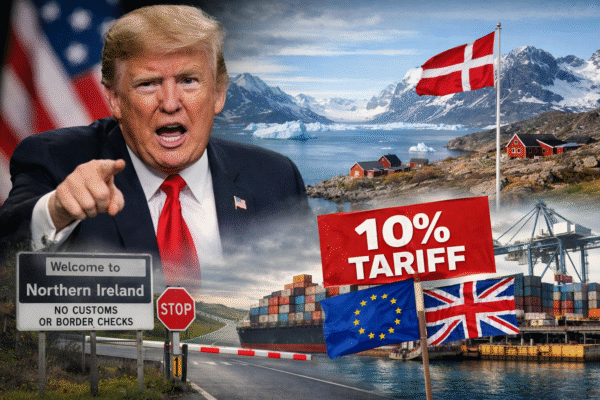
Tensions between Washington and its closest allies have escalated sharply after U.S. President Donald Trump signaled he may impose trade penalties on countries opposing his renewed push to bring Greenland under American control. The proposal has triggered political unease across Europe and raised particular concerns in Northern Ireland, where trade arrangements remain uniquely complex.
Washington Links Trade Pressure to Greenland Talks
In a series of public statements over the weekend, President Trump warned that countries resisting negotiations over Greenland could face a 10% levy on exports to the United States, with the possibility of steeper duties later in the year. The countries mentioned span much of Europe, including the United Kingdom, Denmark, Germany, France, and several Nordic and EU states.
Trump has framed Greenland as a strategic necessity, citing Arctic security, mineral access, and military positioning. However, both Denmark and Greenland’s self-governing authorities have dismissed the idea outright, insisting that sovereignty over the island is not for sale and must remain a matter for its people alone.
Europe Pushes Back Against Trade Coercion
Across the European Union, officials have described the tariff threats as an attempt to use economic leverage to force political concessions. Diplomats in Brussels have begun coordinating a joint response, warning that unilateral trade actions against allies could weaken trust and destabilize long-standing partnerships.
EU leaders are now weighing options ranging from diplomatic engagement to defensive trade measures, with emergency consultations planned to ensure any response is unified and proportionate.
London Rejects Escalation but Draws a Line
UK Prime Minister Sir Keir Starmer has taken a firm but cautious stance, rejecting the use of tariffs as a bargaining tool while also ruling out immediate retaliation. He has warned that trade conflicts between allies risk damaging jobs, investment, and supply chains on both sides of the Atlantic.
Downing Street has emphasized that disagreements over security or diplomacy should be handled through dialogue rather than economic punishment, arguing that escalation would benefit no one.
Why Northern Ireland Is Watching Closely
The situation has particular significance for Northern Ireland, whose post-Brexit trading position places it at the intersection of UK and EU economic systems. Economy Minister Caoimhe Archibald has urged both London and Dublin to take account of how any U.S. tariffs on the UK could have knock-on effects for Northern Irish businesses.
Under the Windsor Framework, Northern Ireland remains aligned with EU rules for goods while also being part of the UK’s customs territory — a dual status that leaves it especially exposed to shifts in international trade policy. First Minister Michelle O’Neill has echoed warnings that sudden tariff changes could disrupt supply chains and investment confidence.
Markets React as Global Risks Grow
Financial markets have already shown signs of unease. Analysts say that even the prospect of escalating tariffs is enough to weigh on investor sentiment, particularly in export-heavy economies. International economic bodies have cautioned that a new round of trade disputes could slow growth and amplify volatility at a time when the global economy remains fragile.
NATO Unity Under Strain
Beyond economics, the dispute has sparked anxiety within NATO. Several European officials fear that linking trade pressure to territorial ambitions risks undermining alliance cohesion, especially in the strategically sensitive Arctic region. Recent military deployments to Greenland, carried out under collective defense arrangements, have further complicated the diplomatic landscape.
An Uncertain Road Ahead
With Denmark refusing to engage in any talks on Greenland’s ownership and European governments preparing a coordinated response, the standoff shows little sign of easing. While Washington has not yet acted on its tariff threats, the episode has exposed deep fault lines in transatlantic relations.
Whether the confrontation leads to compromise or confrontation remains unclear, but it has already highlighted how questions of sovereignty, security, and trade are increasingly intertwined — and how regions like Northern Ireland can find themselves caught in the middle of global power politics.


