
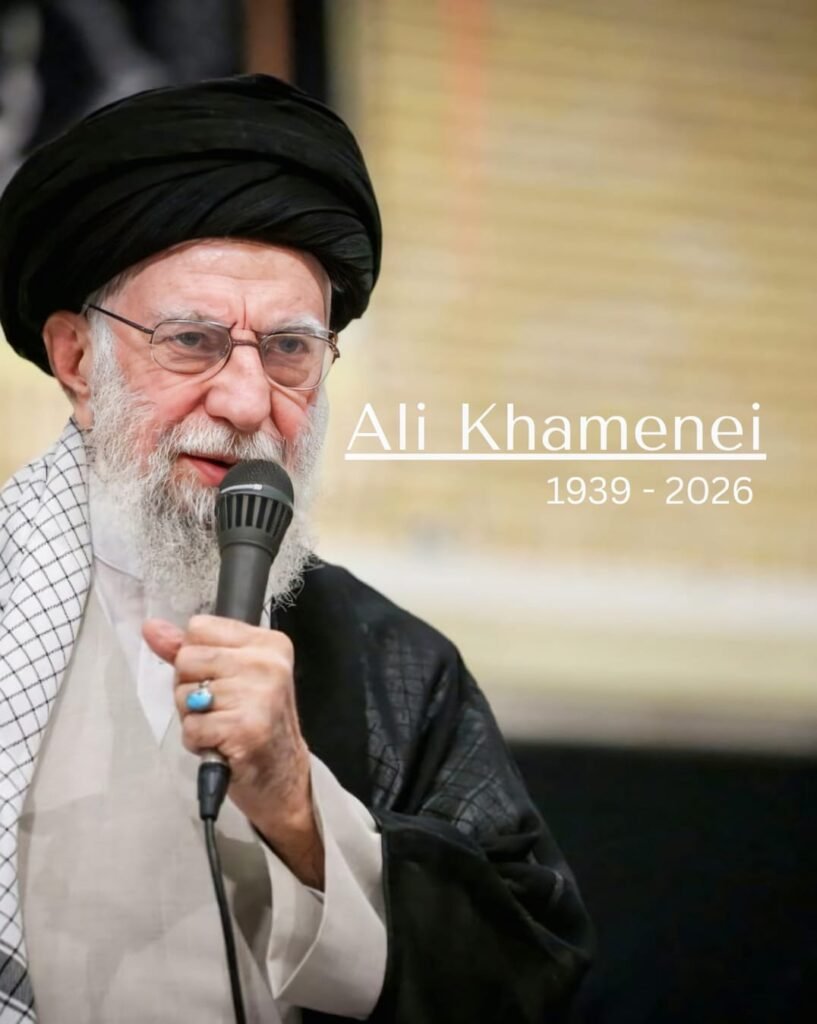
The world witnessed a geopolitical earthquake that reshaped the Middle East and reverberated through global diplomacy. Ayatollah Ali Khamenei, the Supreme Leader of Iran, was confirmed dead at age 86 following a joint military operation by the United States and Israel, an event that instantly became one of the most impactful developments of the decade.
Who Was Ayatollah Ali Khamenei?
Ayatollah Ali Khamenei was born in 1939 in the Iranian city of Mashhad, into a religious family. Early in life, he became actively involved with the clerical opposition to the Shah’s monarchy, aligning himself with Ayatollah Ruhollah Khomeini and the broader revolutionary movement that culminated in the 1979 Islamic Revolution.
Khamenei first rose to prominence within the new Islamic Republic, serving in senior roles including President of Iran and Deputy Minister of Defence. However, his most defining role began in 1989 when he became Supreme Leader, succeeding the revolution’s founder, Ayatollah Khomeini. By constitutional amendment, Khamenei was elevated to the highest authority in Iran’s unique theocratic system, despite initially lacking the highest clerical rank traditionally expected of a supreme leader.
For 37 years, Khamenei was the ultimate decision-maker in Iran — controlling foreign policy, the military, national security, and the judiciary, and wielding influence that few leaders in the region have ever held. His long rule was marked by both unwavering ideological rigidity and strategic political maneuvering.
Circumstances of His Death: A Joint U.S.–Israeli Operation
The circumstances surrounding Khamenei’s death are unprecedented. According to Iranian state media and multiple global reports, he was killed during a coordinated set of airstrikes by the United States and Israel. These attacks, described in some sources as part of an operation named “Operation Epic Fury,” targeted Tehran and other strategic locations in Iran.
While Iranian authorities initially did not describe the exact cause of death, state television later confirmed that the Supreme Leader died following the assault, triggering 40 days of national mourning, a period with deep cultural significance in Shiite Islam known as Arba’een. Flags flew at half-mast, and official statements described Khamenei as having “reached martyrdom.”
Simultaneous reports from U.S. officials, including former President Donald Trump, publicly stated that Khamenei had been killed in the strikes, proclaiming it a pivotal moment and a chance for the Iranian people to take control of their nation’s destiny.
Immediate Reactions: Mourning and Escalation
The response inside Iran was swift and intense. The government declared seven days of public holiday in addition to the extended mourning period. Major Iranian political figures, including President Masoud Pezeshkian, condemned the attack as a “great crime” and vowed strong retaliation.
Iran’s powerful paramilitary force, the Islamic Revolutionary Guard Corps (IRGC), declared that it would launch what it called the “most devastating offensive operation in the history of the Islamic Republic,” raising fears of broader conflict across the region.
Across Tehran and other cities, many citizens took to the streets —some in mourning and others in celebration, reflecting widespread frustration with decades of strict authoritarian rule and economic hardship under sanctions and isolation.
Khamenei’s Legacy: A Complex and Polarizing Leadership
Khamenei’s leadership legacy is deeply contested. To supporters inside Iran’s conservative establishment and to allied regional groups, he was a steadfast defender of Iranian sovereignty and Islamic governance. But to others, both inside and outside Iran, his tenure was synonymous with repression, human rights abuses, and deep economic malaise.
Under his rule, Iran’s nuclear program advanced significantly, leading to repeated international standoffs. Its pursuit of enriched uranium drew sanctions, diplomatic isolation, and multiple military confrontations. Regional conflicts in Iraq, Syria, Lebanon, and Yemen were tied to Iran’s strategy of backing proxy groups, which expanded Tehran’s influence but also entrenched instability.
Internally, mass protests erupted repeatedly — such as in 1999, 2009, and 2022–23 — when citizens demanded greater freedoms and accountability. These movements were largely crushed by security forces, drawing global condemnation for the suppression of dissent.
The Succession Question: Who Comes Next?
One of the most urgent questions facing Iran now is the matter of succession. The Iranian constitution grants the Assembly of Experts the authority to appoint the next Supreme Leader, but the process is not clearly defined in wartime conditions and is complicated by factional rivalries within the clerical establishment.
Various figures have been named in speculation: senior clerics, military leaders, and political heavyweights. The outcome will significantly affect Iran’s domestic policies and its relations with the world.
Global Impact and Future Prospects
The death of Ayatollah Ali Khamenei is more than a historic event for Iran — it’s a potential pivot point in Middle Eastern geopolitics. The removal of such a long-standing and influential leader could open doors to dramatic shifts: from possible domestic political reform to redefined foreign policy alignments.
International markets, particularly oil and defence, have already shown volatility tied to the uncertainty. Nations around the world are watching closely as Iran’s internal dynamics unfold amidst heightened tensions with Western powers and regional rivals.
Conclusion
The death of Ayatollah Ali Khamenei marks the end of an era — the conclusion of a 37-year leadership that shaped Iran’s political, social, and strategic identity. Whether this event brings stability or escalated conflict remains uncertain, but its global impact is undeniable. The process of transition, retaliation, and possible reform will influence not only Iran’s future but also the broader dynamics of Middle Eastern and international politics.


