
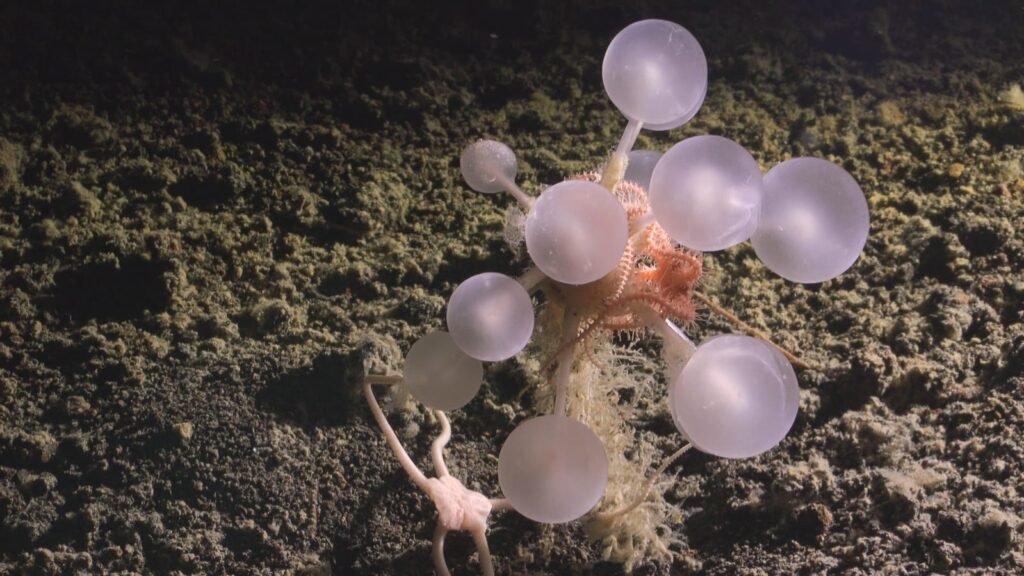
The mysterious depths of Earth’s oceans continue to reveal astonishing forms of life, reminding scientists how little humanity truly understands about the planet’s largest ecosystem. In a remarkable scientific breakthrough, marine researchers recently discovered a strange predatory organism known as the “death-ball sponge” in the remote waters of the Southern Ocean. This unusual deep-sea species has captured the attention of oceanographers and marine biologists worldwide due to its rare carnivorous behavior and unique biological structure.
The discovery was made during a deep-sea expedition exploring unexplored marine ecosystems surrounding Antarctica. The research mission aimed to document unknown marine life living thousands of meters beneath the ocean’s surface. Among dozens of newly identified organisms, the carnivorous sponge stood out as one of the most fascinating and scientifically significant findings.
A Rare Predator Among Sponges
Most sea sponges are known for their passive feeding strategy. Typically, these ancient marine organisms survive by filtering microscopic particles, bacteria, and plankton from surrounding seawater. However, the newly discovered species belonging to the genus Chondrocladia follows a dramatically different survival strategy.
Unlike ordinary filter-feeding sponges, this species is carnivorous. Its unusual spherical body structure—resembling a small “ball” attached to thin stalk-like branches—gives rise to its nickname, the death-ball sponge. The sponge’s surface contains specialized microscopic hooks that allow it to capture small marine organisms drifting through deep-sea currents.
Once prey becomes trapped on the sponge’s surface, specialized cells slowly break down and digest the captured organisms. This hunting mechanism allows the sponge to thrive in extremely nutrient-poor environments where traditional filter feeding may not provide enough energy for survival.
The Deep-Sea Environment Where It Lives
The carnivorous sponge was discovered at an extraordinary depth of more than 3,000 meters beneath the surface of the Southern Ocean. At these depths, sunlight cannot penetrate, temperatures remain close to freezing, and pressure reaches extreme levels that would be fatal to most forms of life.
Despite these harsh conditions, deep-sea ecosystems host a surprising diversity of organisms uniquely adapted to survive in darkness. Marine researchers increasingly believe that the ocean floor surrounding Antarctica may contain thousands of undiscovered species that have evolved in isolation for millions of years.
These ecosystems remain largely unexplored due to the technological challenges involved in deep-sea exploration. Scientists rely on remotely operated vehicles and advanced underwater cameras to document life forms living in these extreme environments.
A Landmark Scientific Expedition
The discovery of the death-ball sponge occurred during a major international marine research expedition conducted as part of the Ocean Census program. This initiative aims to accelerate the discovery and documentation of unknown marine species across the world’s oceans.
Using advanced underwater exploration technology, scientists collected biological samples and high-resolution footage from remote sections of the Antarctic seabed. During the expedition, researchers identified approximately thirty previously unknown marine species, including rare starfish, deep-sea corals, and unusual crustaceans.
Among these discoveries, the carnivorous sponge attracted particular interest because predatory sponges are relatively rare in marine ecosystems. Their unusual feeding behavior challenges traditional scientific assumptions about sponge biology and evolutionary adaptation.
Why the Discovery Matters
The identification of a new carnivorous sponge species highlights the extraordinary biodiversity that exists within the deep ocean. Scientists estimate that more than 80 percent of the world’s ocean remains unexplored, suggesting that millions of undiscovered species could still inhabit the planet’s marine environments.
Understanding these organisms plays a crucial role in expanding scientific knowledge about Earth’s biological diversity. Deep-sea species often possess unique biochemical compounds that may have potential applications in medicine, biotechnology, and environmental science.
Marine sponges in particular are known to produce complex chemical substances used for defense against predators and microbial infections. Researchers believe that studying newly discovered species like the death-ball sponge may lead to future breakthroughs in pharmaceutical research, including the development of new antibiotics or anticancer compounds.
The Importance of Ocean Exploration
The discovery also underscores the importance of continued investment in ocean exploration programs. Although the deep ocean represents the largest ecosystem on Earth, it remains far less studied than terrestrial environments.
Organizations such as Ocean Census are working to change this by launching global scientific missions dedicated to documenting marine biodiversity. By identifying new species and mapping unexplored habitats, scientists hope to better understand how ocean ecosystems function and how they may respond to environmental changes.
These efforts are particularly important as climate change and human activity increasingly affect marine environments. Protecting fragile ecosystems requires accurate scientific knowledge about the organisms that inhabit them.
A Reminder of the Ocean’s Mysteries
The discovery of the carnivorous death-ball sponge in the depths of the Southern Ocean serves as a powerful reminder of the ocean’s enduring mysteries. Even in the twenty-first century, vast regions of the seabed remain unexplored, hiding extraordinary life forms adapted to some of the most extreme conditions on Earth.
For marine scientists, each new discovery represents another piece of the puzzle that helps explain the complex web of life beneath the waves. As exploration technologies continue to advance, researchers expect that many more remarkable species will emerge from the dark depths of the ocean.
Ultimately, discoveries like the death-ball sponge not only expand our understanding of marine biodiversity but also highlight the importance of preserving Earth’s oceans for future generations. The deep sea remains one of the final frontiers of scientific exploration—and its secrets are only beginning to be revealed.