
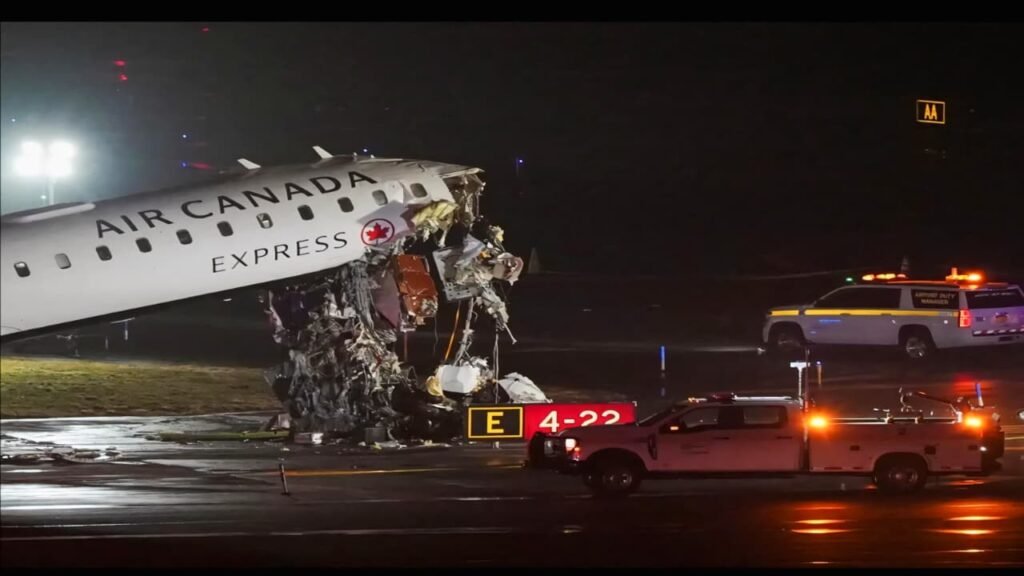
A Routine Landing Turns Catastrophic
On March 23, 2026, a routine domestic flight turned into a devastating aviation incident when Air Canada Express Flight 8646 was involved in a fatal runway collision at LaGuardia Airport. The aircraft, arriving from Montreal, collided with an airport ground vehicle during landing, resulting in the tragic loss of two pilots and injuries to dozens of passengers and crew.
The incident has reignited global discussions runway safety, air traffic control coordination, and aviation risk management. As investigations unfold, the crash stands as a stark reminder that even highly regulated aviation systems are not immune to critical failures.
Inside the Incident: What Happened on the Runway
Preliminary reports indicate that the aircraft was cleared to land while a fire response vehicle was simultaneously present on the same runway. This apparent miscommunication led to a high-impact collision at a critical phase of flight—landing.
Runway incursions, defined as unauthorized presence of an aircraft, vehicle, or person on a runway, are among the most dangerous aviation hazards. In this case, the convergence of two authorized entities suggests a systemic lapse rather than isolated human error.
Casualties and Emergency Response
The crash resulted in the deaths of both pilots, whose efforts to control the aircraft in its final moments are being widely acknowledged. Over 40 individuals sustained injuries, ranging from minor to critical, including passengers, crew members, and ground personnel.
Emergency services responded rapidly, evacuating passengers and securing the crash site. Hospitals across New York received the injured, with most reported to be in stable condition. The survival of the majority onboard has been described as remarkable, given the severity of the collision.
Airport Disruption and Operational Impact
Following the incident, operations at LaGuardia Airport were immediately suspended. Hundreds of flights were delayed or canceled, causing widespread disruption across domestic air travel networks.
The ripple effect extended beyond New York, impacting connecting flights and airline schedules across North America. Aviation analysts note that such disruptions highlight the interconnected nature of modern air travel systems, where a single can cascade into global logistical challenges.
Investigation Underway: Uncovering the Cause
Authorities including the National Transportation Safety Board have launched a comprehensive investigation. Key areas of focus include:
- Air traffic control communication protocols
- Runway clearance procedures
- Coordination between ground vehicles and incoming aircraft
- Emergency response timing and positioning
Investigators will analyze cockpit voice recorders, flight data systems, and air traffic control transcripts to reconstruct the sequence of events. Early indications suggest that communication breakdown may have played a central role.
Runway Safety: A Critical Weak Point in Aviation
Despite advancements in aviation technology, runway safety remains a persistent challenge. Airports handle thousands of movements daily, requiring flawless coordination between pilots, controllers, and ground staff.
Technologies such as runway surveillance radar and automated warning systems exist but are not universally implemented or consistently utilized. This incident may accelerate calls for mandatory adoption of advanced safety systems across all major airports.
Human Factors and Systemic Risks
Aviation experts emphasize that accidents rarely result from a single failure. Instead, they emerge from a chain of human and systemic errors. Fatigue, workload, and communication ambiguity can all contribute to critical lapses.
In high-pressure environments like busy urban airports, even minor misjudgments can have catastrophic consequences. This underscores the need for continuous training, clear communication standards, and redundancy in safety systems.
Global Implications for the Aviation Industry
The crash of Flight 8646 has implications far beyond a single airline or airport. It raises fundamental questions about how aviation systems manage risk in increasingly congested airspaces.
Regulatory bodies worldwide may revisit safety guidelines, particularly regarding runway operations and ground vehicle coordination. Airlines and airports alike are expected to review internal protocols to prevent similar incidents.
Conclusion: A Call for Safer Skies
The tragedy involving Air Canada Express Flight 8646 is both a human loss and a systemic warning. While aviation remains one of the safest modes of transport, incidents like this reveal vulnerabilities that demand urgent attention.
As investigations continue, the lessons learned must translate into actionable reforms. Enhanced technology, stricter protocols, and improved communication systems are essential to ensuring that such tragedies do not recur.
In an era of increasing air travel demand, safety cannot be compromised. The skies must remain not only accessible—but secure.


