
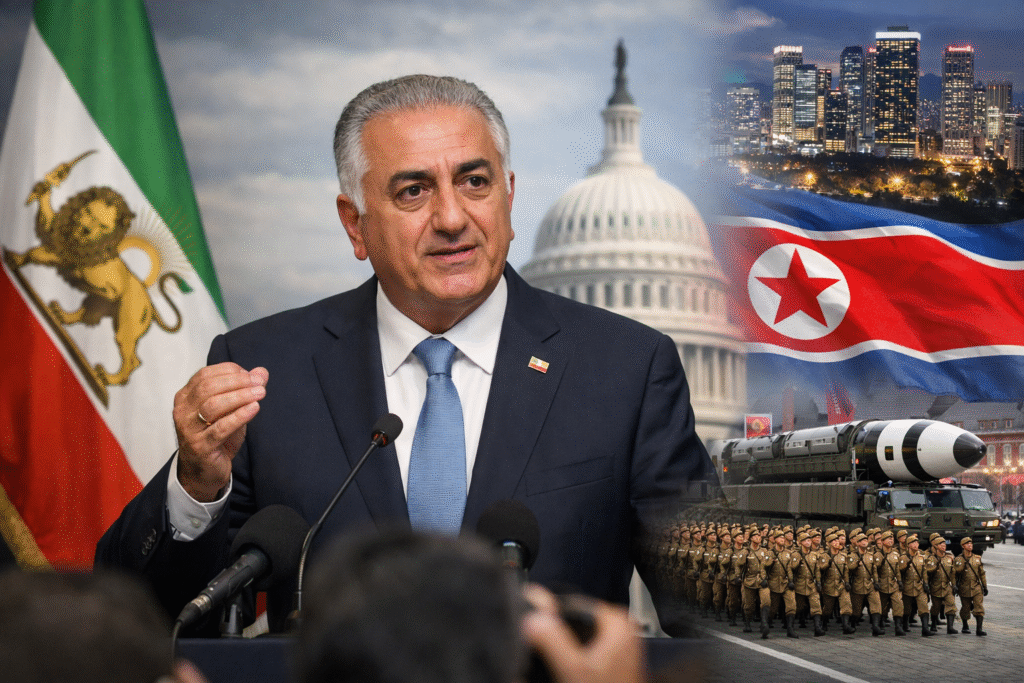
Reza Pahlavi, 65-year-old son of Iran’s last monarch and a central figure in the country’s opposition movement, used a press conference in Washington, D.C. this week to cast Iran’s modern trajectory as a tragedy of squandered promise — likening the Islamic Republic to “North Korea” instead of the “South Korea of the Middle East” it could have become.
Addressing journalists and international advocates, Pahlavi argued that before the 1979 revolution Iran’s economy was stronger than South Korea’s, but decades of authoritarian rule, isolation, and economic mismanagement deprived citizens of prosperity and global integration. He said the current regime’s policies have degraded living standards, exploited national resources, and reinforced a cycle of repression.
From Exile to Opposition Leadership
Living outside Iran since his family’s overthrow, Pahlavi has emerged during the ongoing nationwide protests as one of the most visible opposition voices. With protests continuing across major cities, he insists that the clerical regime’s fall is “inevitable” — a stance that resonates with many Iranians tired of inflation, censorship, and violent crackdowns.
At the Washington gathering, Pahlavi framed the current struggle not merely as reform but as a contest between liberation and occupation, urging the international community to increase political and economic pressure on Tehran. He called specifically for measures to protect civilians, cut off resources of hard-line leadership, and enhance communications inside Iran through satellite internet and similar technologies.
Pahlavi also claimed that elements of Iran’s security forces and military quietly support the protest movement, suggesting potential fractures within the state’s coercive apparatus. Whether these claims reflect widespread defections remains debated among analysts.
Vision for a Post-Regime Iran
While Pahlavi’s critics point to internal divisions within Iran’s opposition and question his decades abroad, he continues to outline a future vision for the nation that emphasizes democratic values, economic renewal, and normalized relations with the global community. Part of his proposed roadmap includes a national referendum on the structure of government after regime change — offering Iranians a choice between a restored constitutional monarchy or a republic.
He has also floated a “Cyrus Accord,” aimed at swiftly normalizing ties with long-estranged neighbors including Israel, and pledged to abandon Iran’s contentious nuclear ambitions in exchange for the lifting of sanctions.
A Movement Without a Single Leader?
Despite his prominence abroad, Pahlavi’s stature inside Iran is more complex. Many opposition activists remain wary of centralized leadership or associate the Pahlavi name with past autocratic rule. Internal divisions among dissident groups — from republicans to ethnic minority organizations — continue to challenge unified planning for a post-regime transition.
Nevertheless, called chants such as “This is the final battle — Pahlavi will return” have surfaced during protests, showing significant symbolic resonance among parts of the movement, though they don’t represent consensus across all factions.
Conclusion
At a moment of intense upheaval, Reza Pahlavi stands as both a symbol of historic continuity and a controversial figure within Iran’s quest for change. His narrative — from comparing Iran’s lost economic promise to calling for an internationally supported transition — reflects broader tensions in the diaspora and among Iranians at home about the nation’s future. Whether his vision will play a pivotal role in shaping that future remains uncertain, but his voice is undeniably central in global conversations about Iran’s next chapter.


