
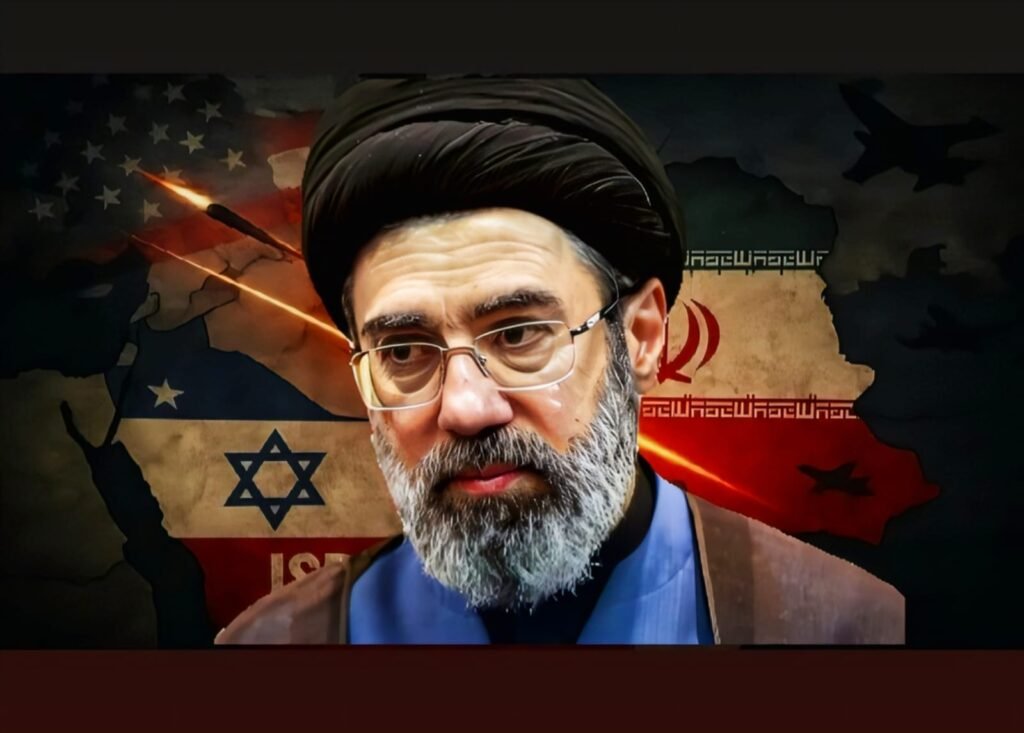
In an unprecedented chapter of Middle Eastern politics, Mojtaba Khamenei, son of the late Ali Khamenei, has reportedly been elected as Iran’s new Supreme Leader — a succession that has sent seismic ripples through regional geopolitics, international diplomacy, and global security calculations. This moment marks only the second transfer of supreme authority in the 47-year history of the Islamic Republic, and comes at a time when Iran is engulfed in intensifying conflict with the United States, Israel, and proxy networks throughout the Middle East. (www.israelhayom.com)
A Turbulent Succession: A New Era Begins
The sudden death of Ayatollah Ali Khamenei — confirmed by multiple credible outlets following joint U.S.–Israeli strikes on his compound — triggered an urgent leadership vacuum within Iran’s theocratic power structure. This strategic leadership decapitation thrust Iran into a potentially destabilizing crisis, with implications that extend far beyond its borders.
The constitution of the Islamic Republic vests the power to appoint a Supreme Leader in the Assembly of Experts, an 88-member body of Shiite clerics elected to oversee and elect the highest authority in the land. In this high-stakes environment, Iran’s clerical and security elites converged behind Mojtaba Khamenei — a figure long regarded as influential behind the scenes, though never formally part of the public political hierarchy.
Who Is Mojtaba Khamenei?
Born in 1969 in Mashhad, Mojtaba Khamenei is the second son of Iran’s long-time supreme leader. Unlike his father, he never held prominent official office, nor did he preside over major religious institutions publicly. Yet for years, analysts have cited his significant influence within Iran’s domestic political and security landscape. He has been described as a key arbiter between clerical authority and the powerful Islamic Revolutionary Guard Corps (IRGC), with ties that arguably shaped internal power alignments long before his reported elevation.
At 56, Mojtaba’s rise challenges conventional expectations for Iran’s leadership succession. Historically, the position of supreme leader has not followed hereditary lines — a legacy of the revolution that overthrew the Shah in 1979 and rejected monarchical rule. Critics argue that transferring theocratic authority from father to son introduces a quasi-dynastic element into a republic founded on theocratic principles. This perception fuels debates over legitimacy both inside Iran and abroad.
The Role of the IRGC and Power Dynamics
Reports suggest that the IRGC played a pivotal role in rallying support for Mojtaba’s candidacy, emphasizing a need for continuity in hardline policies as regional conflict intensifies. The Guard’s influence in the selection process — according to informed sources — underscores how security considerations and institutional interests now shape the evolution of Iran’s political elite.
Mojtaba is known for his more hardline stance compared to many clerical counterparts. Observers note that he maintained close relations with Iran’s military establishment and played informal roles in suppressing domestic dissent and coordinating internal strategy. His elevation, therefore, signals a prioritization of continuity and security consolidation over reforms or ideological moderation.
Regional and International Repercussions
The naming of Mojtaba Khamenei carries huge geopolitical weight. With Iran embroiled in confrontation with the U.S. and Israel, his leadership appointment could harden Tehran’s posture in the ongoing Middle East conflict, particularly with proxy groups such as Hezbollah and allied militias. Analysts view the leadership transition not only as a consolidation of clerical power, but also as a reaffirmation of Iran’s capacity to sustain its strategic interests amid intensive external pressure.
International reactions have varied: Western powers and regional alliances are monitoring how this leadership shift will affect diplomatic overtures, nuclear negotiations, and security cooperation. Europe’s foreign policy leaders have expressed cautious optimism for stabilizing the situation, even as they warn against deeper military escalation.
Internal Challenges and Legitimacy Questions
Inside Iran, uncertainty lingers. Some clerics initially voiced concern over naming a successor perceived to lack traditional religious credentials and public legitimacy. Moreover, the speed with which the transition has unfolded raises questions about transparency and constitutional adherence. Reports indicate that the Assembly of Experts accelerated proceedings amid security threats, even conducting remote deliberations after targeted strikes on clerical infrastructure. (Azat TV)
Furthermore, the absence of a formal state media announcement has fed speculation and confusion domestically, despite multiple credible international reports citing Iranian sources. The lack of clarity — at least publicly — about Mojtaba’s endorsement reflects broader tensions between Iran’s internal politics and its external messaging.
A Defining Moment for an Aged Republic
For decades, Iran’s supreme leader held unparalleled authority over state affairs — shaping foreign policy, security strategy, and ideological doctrine. Ali Khamenei’s legacy was rooted in a blend of revolutionary rhetoric and pragmatic, often ruthless political control. His death and the subsequent rise of Mojtaba mark a turning point that may redefine Iran’s governance and influence in the world.
The new leadership’s challenges are immense: navigating war pressures, internal dissent, economic sanctions, and complex international negotiations. Mojtaba’s ascent heralds a new era — one in which Iran must balance internal cohesion with external conflict, all while trying to legitimize a succession that many outside observers see as controversial.
Conclusion: The Road Ahead
As Mojtaba Khamenei steps into the global spotlight, his leadership will be scrutinized by the international community, rival powers, and Iranian citizens alike. The melding of traditional theocratic authority with a hardline security establishment could recalibrate the political landscape of the Middle East. Whether his tenure ushers in consolidation or further instability remains to be seen, but one thing is clear: Iran’s pivot into a new epoch under Mojtaba’s leadership will be one of the most consequential geopolitical developments of 2026 and beyond.


