
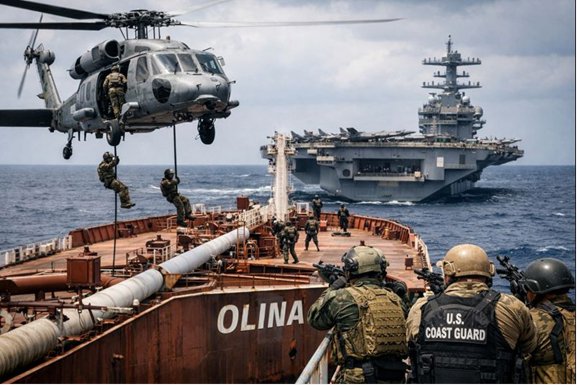
Washington, D.C. In a significant escalation of its naval enforcement campaign against Venezuelan oil exports, U.S. forces on Friday seized the fifth oil tanker Olina in the Caribbean Sea, marking the fifth vessel apprehended in recent weeks as part of President Donald Trump’s blockade and sanctions enforcement operation.
The operation was carried out in international waters during a pre-dawn raid involving U.S. Marines, Navy personnel, and Coast Guard units launched from the aircraft carrier USS Gerald R. Ford, according to U.S. Southern Command (SOUTHCOM) and Homeland Security officials.
Targeting the “Ghost Fleet”
Homeland Security Secretary Kristi Noem described the Olina as part of a so-called “ghost fleet” — a network of tankers suspected of carrying embargoed Venezuelan oil and evading tracking systems and sanctions. In social media posts, Noem emphasized that these vessels attempted to break through the U.S. naval blockade and make their way back to Venezuelan waters.
Public ship registries and maritime analysts indicate that the Olina was previously sanctioned and had been sailing under questionable flags, including a false registration claiming Timor-Leste nationality. Its transponder had reportedly been turned off for weeks, a tactic used to avoid detection.
Part of a Broader Campaign
This latest seizure is part of a larger U.S. strategy known internally as Operation Southern Spear, which aims to prevent Venezuelan crude from leaving or entering the country in violation of sanctions imposed by Washington.
In early January, U.S. forces also captured a Russia-linked tanker after a weeks-long pursuit across the North Atlantic, a move that drew criticism from Moscow, which condemned the action as unlawful.
Officials say the blockade and seizures are designed to tighten pressure on the government of Venezuelan leader Nicolás Maduro, whose leadership was dramatically struck earlier this month during a U.S. raid in Caracas that resulted in his capture on drug-trafficking charges.
Message to Smugglers and Foreign Powers
SOUTHCOM highlighted that the operation involving Marines descending from helicopters and Coast Guard boarding parties underscores the seriousness with which the U.S. is treating sanction-evasion efforts. “There is no haven for criminals,” the command stated in a social media post.
The repeated seizures have triggered diplomatic tensions, particularly with Russia, which has seen one of its tankers intercepted after attempting to use its flag to shield the vessel from U.S. jurisdiction.
Economic and Geopolitical Stakes
The campaign has broader implications for global oil markets and geopolitical alignments. Venezuela holds some of the world’s largest proven oil reserves, and the U.S. seeks not only to enforce sanctions but also to exert influence over how Venezuelan crude is sold and distributed in world markets.
While U.S. officials frame the seizures as legal enforcement of sanctions, critics argue the blockade ventures into murky international waters and raises questions of Maritime law and sovereignty. Some Maritime analysts also note that satellite imagery shows several sanctioned tankers evading the blockade and dispersing across the Atlantic and the Caribbean, highlighting the challenge of enforcing such a naval operation.


