
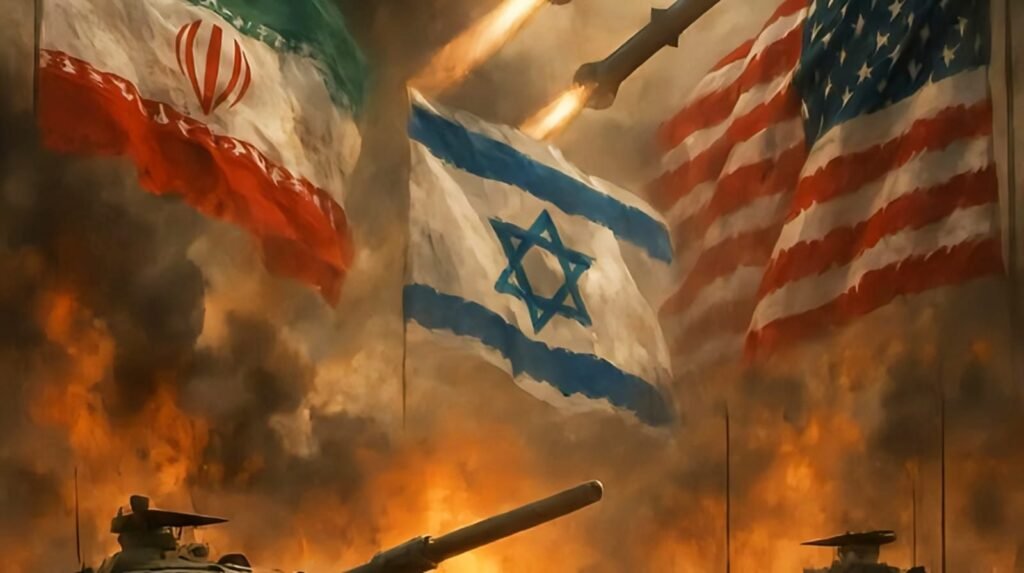
Iran, United States and Israel has been evolved into very core conflict that has been became a multi dimensional war. Where these three states are directly or indirectly engaged between very complex situation. After February 2026 things got a bit out of hands when USA and Israel targets military bases nuclear facilities and missile infrastructure so in an effort to weaken Iran’s strategic capabilities. In response, Iran strongly reacts by targeting cities of Israel and military bases of USA through drones and missiles. Due to this missile exchange both countries faced very difficulties. Infrastructure got disturbed and war zone became very serious Iran–U.S.–Israel conflict is not a traditional war but a technologically advanced, multi-layered confrontation with both regional and global implications.
Lebanon Front Erupts: Hezbollah–Israel Clashes Deepen Regional Conflict
The situation on the Lebanon front escalated significantly when Hezbollah initiated attacks against Israel, using rockets and missiles. In response Israel airstrikes Lebanon where it targets bases of Hezbollah and damage the infrastructure. Back to back strikes gradually gradually intensified the situation Consequently, Lebanon also became a wide part of the conflict. The impact has been most severe on civilians, with thousands affected either directly or indirectly. Many people have been forced to leave their homes, while essential infrastructure and public services have also suffered considerable damage. As a result, the Lebanon front has further complicated the conflict, transforming it into a wider regional crisis.
Persian Gulf on Edge: Rising Regional Tensions Risk Drawing Gulf States Into Wider Conflict
In Persian Gulf region, countries such as Saudi Arabia, the United Arab Emirates, and Kuwait are witnessing a rise in a indirect involvement in US-Iran-Israel conflict. Rising in regional tensions have placed these Gulf states on high alert missile activity have created serious security concerns. Although these countries are not directly part of the main battlefield, their strategic importance and close alliance with the United States make them vulnerable to spillover effects. As a consequence, their air defense systems continue to operate on high alert, while regional governments are closely tracking developments. This increasing instability has intensified concerns that any further escalation could potentially draw these nations further into the conflict, transforming indirect pressure into potential direct involvement.
From Local Conflict to Regional Crisis: Ongoing Middle East Tensions Explained
Overall, this situation has now turned into a wider regional crisis instead of just a small conflict between a few countries. Because it is continuing, it is raising serious concerns about more escalation, the possible involvement of other countries, and long-term effects on regional peace, global trade, and international relations. At the same time, the situation is changing every day, as talks and diplomatic efforts are still happening, even while military actions and responses from different sides continue.
Consequences
The expansion of conflict across multiple countries has serious and far-reaching consequences for regional and global stability. As more states become directly or indirectly involved, the risk of a larger and more uncontrollable war increases significantly. This leads to widespread insecurity, disruption of civilian life, and large-scale humanitarian challenges, including displacement of populations and damage to critical infrastructure. Economically, such escalation affects global trade routes, energy supplies, and financial markets, creating instability far beyond the immediate conflict zones. Politically, it weakens diplomatic trust between nations and reduces the chances of peaceful resolution, as alliances become more rigid and tensions deepen. Overall, a multi-country war expansion transforms a regional issue into a global concern with long-term consequences for peace, security, and international cooperation.


