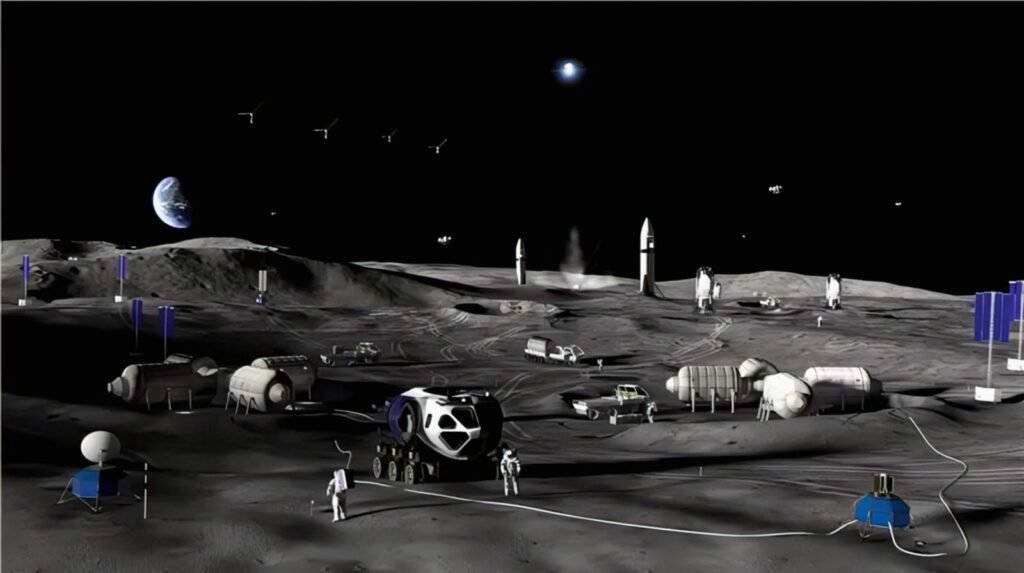
According to Moon Base Plan, NASA uses a very clever yet alternative strategy in their plan. Initial plan was to send a space station around Moon’s orbit However, they shift the focus on Moon surface by setting a lunar base. The main moto is to send a human to Moon for Prolonged period of time for researching and expedition. Advanced technology will be used in this base, including robots, automated systems, and potential nuclear energy sources to ensure a continuous power supply. This base is also expected to serve as a starting point for future missions, especially those planned for Mars. In this way, NASA’s new approach is making space exploration more practical and focused on long-term goals.
Shift from Space Station to Moon Surface Base
NASA has changed its earlier strategy, where the original plan was to build a space station in the Moon’s orbit. Now, the focus has shifted toward establishing a base directly on the Moon’s surface. This change will allow astronauts to work directly on the lunar surface, leading to more effective and in-depth research.
Nuclear Power Systems for Lunar Base
Nuclear power systems are expected to play an important role in supporting future lunar bases. Since the Moon has long nights and limited sunlight in some areas, solar energy alone may not be enough for continuous operations. Nuclear energy can provide a stable and long-lasting power supply for essential systems like life support, communication, and scientific equipment. It can also help run robots and automated machines without interruption. In this way, nuclear power ensures that the lunar base remains functional and reliable for long-term missions.
Gateway for Future Mars Missions
This Moon base will serve as a training and launch point for future space missions, especially those directed towards Mars. From here, astronauts will be prepared for deep space missions, and new technologies will be tested to support long-distance travel. This setup will play an important role in helping humanity reach Mars and beyond. It will also allow scientists to study space conditions in a real environment. Additionally, it will help improve mission safety and efficiency for future interplanetary travel.
Sustainable Life Support Systems
A lunar base will require advanced life support systems to ensure astronauts can survive in a harsh environment. These systems will manage oxygen supply, water recycling, and food production in a controlled setup. Since the Moon has no natural atmosphere, everything must be carefully maintained through technology. Scientists are developing closed-loop systems to reuse resources efficiently. This will reduce dependency on Earth for regular supplies. Such systems are essential for long-duration missions. They will also help improve survival techniques for future deep space exploration.
Robotics and Automation in Operations
Robots and automated systems will play a key role in building and maintaining the Moon base. These machines can work in extreme conditions where human presence is limited or risky. They will assist in construction, repairs, and scientific experiments. Automation will also help reduce human workload and increase efficiency. AI-powered systems may control daily operations of the base. This technology will make the base more self-sufficient. Over time, robots will become an essential part of lunar infrastructure development
Scientific Research and Lunar Exploration
The Moon base will provide a unique platform for advanced scientific research. Scientists will study lunar soil, space radiation, and the Moon’s environment in detail. It will also help in understanding the early history of the solar system. Experiments conducted there will be more accurate than those done from Earth. Researchers will also test new space equipment in real conditions. This will improve future mission planning and design. Overall, it will significantly expand human knowledge of space.
Overall, the Moon Base Plan represents a major shift in NASA’s long-term space strategy. It is no longer limited to short-term visits but focuses on building a permanent presence beyond Earth. This approach will open new opportunities for scientific research and technological development. It will also strengthen future missions aimed at Mars and deeper space exploration. Although challenges remain, continuous progress is being made in this direction. In the coming years, this plan could redefine how humanity explores and utilizes space.